
Interests: Helping, Persuading, Thinking
Career Cluster: Technology
Education Level: Bachelor’s Degree
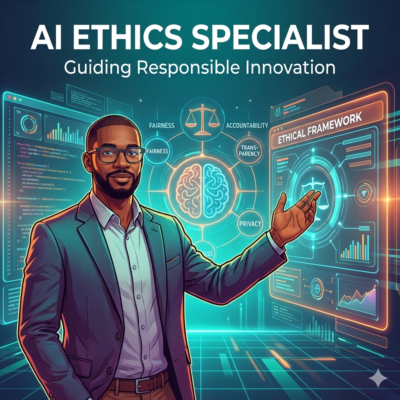
An AI ethics specialist focuses on addressing ethical considerations and implications associated with the development, deployment, and use of Artificial Intelligence (AI) technologies.
What is a typical day as an AI Ethics Specialist?
Conduct ethical assessments of AI systems and applications to evaluate their potential impacts on individuals, communities, and society as a whole
Identify and mitigate biases and discrimination in AI algorithms and datasets to ensure fairness, equity, and inclusivity in AI applications.
Develop guidelines, frameworks, and policies for responsible AI development and deployment that align with ethical principles, human rights, and societal values.
Collaborate with policymakers, regulatory agencies, and industry stakeholders to advocate for ethical standards and best practices in AI governance and regulation.
Foster dialogue and collaboration to address ethical challenges and promote transparency, accountability, and public trust in AI technologies.
Assess the potential social, economic, and cultural impacts of AI technologies on individuals, communities, and society.
Identify opportunities to maximize positive impacts and mitigate negative consequences through ethical design, implementation, and governance of AI systems.
What else might they be expected to do?
Provide education, training, and awareness-raising activities on AI ethics for developers, researchers, policymakers, and other stakeholders.
Establish and participate in ethics review boards or committees to review and evaluate AI research proposals, projects, and applications from an ethical perspective
Advocate for ethical AI practices and policies through thought leadership, public speaking, and participation in professional networks and forums.
Contribute to the advancement of AI ethics research, scholarship, and discourse through publications, conferences, and collaborative initiatives.
What type of training is needed for this career path?
Start by obtaining a bachelor’s degree in a relevant field such as philosophy, ethics, computer science, law, sociology, or a related discipline.
A strong foundation in ethical theory, technology, and social sciences is essential for understanding the ethical implications of AI technologies.
Consider pursuing advanced education or training programs specifically focused on AI ethics, such as a Master’s or Doctoral Degree in Ethics, Technology Ethics, Applied Ethics, or AI Ethics.
Build a portfolio of projects, research papers, case studies, and publications that demonstrate your expertise and contributions to the field of AI ethics.
What kind of personality is needed to excel in this career path?
Analytical Thinking
Attention to Detail
Critical Thinking
Integrity
What kind of interests do people in this career path have?
Thinking (Investigative) – They enjoy analyzing problems, conducting research, evaluating data, and forming ethical frameworks for AI systems.
Helping (Social) –They are driven by the desire to protect individuals, communities, and vulnerable groups from harm caused by biased or irresponsible AI.
Persuading (Enterprising) –They often need to advocate for ethical practices, influence company policies, and communicate complex ideas to stakeholders.
Holland Codes: Thinking (T), Persuading (P) and Helping (H).
Are there any innate skills or aptitudes required?
Strong critical
A natural sensitivity to fairness, justice, and societal impact is essential when analyzing ethical dilemmas.
Communication skills
Understanding diverse perspectives and anticipating how AI decisions affect people.
Analytical mindset
What challenges can I expect to face if I pursue this career path?
Rapidly evolving technology
Ambiguity in ethical standards
Balancing innovation vs. ethics
Complex interdisciplinary knowledge
Resistance to change
Cultural and legal differences
What are the job prospects for this path in Kenya and Africa? What about International prospects for a Kenyan citizen?
– Kenya and Africa:AI is an emerging field across Africa, with growing interest in ethical use of technology. In Kenya, opportunities exist mainly in tech companies, universities, government agencies, and NGOs focusing on AI policy and ethics.
– International: Globally, demand for AI Ethics Specialists is rising, especially in tech hubs in the US, UK, EU, and Asia. Kenyan citizens with strong skills and qualifications can find opportunities in multinational firms, research institutions, and international organizations focusing on AI governance, regulation, and ethics.
What should I focus on if I choose to pursue this career?
Building a strong foundation in AI, computer science, and philosophy or ethics.
Studying laws and regulations related to data privacy, AI governance, and digital rights.
Developing critical thinking and analytical skills to evaluate ethical implications of AI systems.
Staying updated on emerging AI technologies and ethical debates globally.
Networking with professionals in AI, law, and ethics through conferences, workshops, and online forums.
Pursuing relevant certifications or advanced degrees in AI ethics, data ethics, or related fields.
Which other careers or job roles can I progress to?
AI Ethics Policy Analysts
Corporate Ethics Officer
AI Ethics Consultants
AI Ethics Educators