
Interests: Building, Organizing, Thinking
Career Cluster: Environment and Agriculture
Education Level: Bachelor’s Degree, Master’s Degree
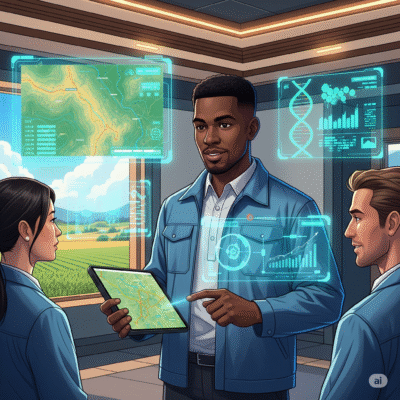
This is an emerging career that applies geospatial technologies, including drones, to agricultural production or management activities, such as pest scouting, site-specific pesticide application, yield mapping, or variable-rate irrigation. May use computers to develop or analyze maps or remote sensing images to compare physical topography with data on soils, fertilizer, pests, or weather.
What is a typical day as a Precision Agriculture Technician?
– Document and maintain records of precision agriculture information.
– Collect information about soil or field attributes, yield data, or field boundaries, using field data recorders and basic geographic information systems (GIS).
– Use drone technology to develop soil sampling grids or identify sampling sites for testing characteristics such as nitrogen, phosphorus, or potassium content, pH, or micronutrients.
– Programming and maintaining equipment for precise input application.
– Monitoring crop health through remote sensing and field scouting.
What else might they be expected to do?
– Calibrating and troubleshooting precision equipment.
– Collaborating with farmers and agronomists to implement data-driven strategies.
– Updating digital records and preparing reports.
What type of training is needed for this career path?
– Diploma or Bachelor’s Degree in fields like Geomatic Engineering, Agronomy, or Precision Agriculture
– Short Courses in GIS and precision farming technologies.
What kind of personality is needed to excel in this career path?
– Dependability — Job requires being reliable, responsible, and dependable, and fulfilling obligations.
– Integrity — Job requires being honest and ethical.
– Attention to Detail — Job requires being careful about detail and thorough in completing work tasks.
– Adaptability/Flexibility — Job requires being open to change (positive or negative) and to considerable variety in the workplace
– Persistence — Job requires persistence in the face of obstacles.
What kind of interests do people in this career path have?
– Work involves designing, building, or repairing of equipment, materials, or structures, engaging in physical activity, or working outdoors (Building)
– Work involves studying and researching non-living objects, living organisms, disease or other forms of impairment, or human behavior (Thinking)
– Work involves following procedures and regulations to organize information or data, typically in a business setting. (Organising)
Holland Codes: Thinking (T), Building (B) and Organising (O).
Are there any innate skills or aptitudes required?
– Technical Proficiency: Comfortable with GPS, GIS, and data analysis software.
– Analytical Thinking: Ability to interpret complex data sets.
– Attention to Detail: Ensures accuracy in data collection and equipment calibration.
– Communication Skills: Effectively conveys technical information to non-specialists.
– Adaptability: Stays updated with evolving agricultural technologies.
What challenges can I expect to face if I pursue this career path?
– Technological Barriers: Limited access to advanced equipment in some regions.
– Skill Gaps: Need for continuous learning to keep pace with technological advancements.
– Environmental Factors: Unpredictable weather patterns affecting data reliability.
What are the job prospects for this path in Kenya and Africa? What about International prospects for a Kenyan citizen?
– Kenya & Africa: Government and NGO initiatives are promoting precision agriculture to enhance food security.
– International: Opportunities exist in countries investing in smart farming technologies.
What should I focus on if I choose to pursue this career?
– Technical Skills: Mastery of precision agriculture tools and software.
– Data Analysis: Ability to interpret and apply data for decision-making.
– Sustainability Practices: Understanding of environmentally friendly farming methods.
– Communication: Skills to educate and collaborate with farmers and stakeholders.
Which other careers or job roles can I progress to?
– Agricultural Engineers
– Agricultural Technicians
– Conservation Scientists
– Geological Technicians
– Soil and Plant Scientists