
Interests: Building, Organizing, Thinking
Career Cluster: Healthcare and Medicine
Education Level: Master’s Degree
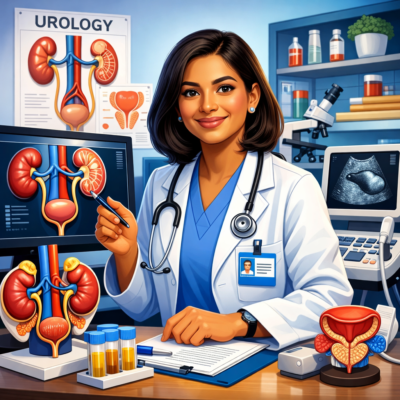
Urologists diagnose, treat, and help prevent benign and malignant medical and surgical disorders of the genitourinary system and the renal glands.
What is a typical day as an Urologist?
– Attend clinics and to examine, diagnose or review patients.
– Diagnose or treat diseases or disorders of genitourinary organs and tracts including erectile dysfunction (ED), infertility, incontinence, bladder cancer, prostate cancer, urethral stones, or premature ejaculation.
– Examine patients using specilised equipment to determine the nature and extent of disorder or injury.
– Order and interpret the results of diagnostic tests
– Prescribe or administer antibiotics, antiseptics, or compresses to treat infection or injury
What else might they be expected to do?
– Follow-up care: After treatment, a urologist is responsible for monitoring the patient’s condition and providing follow-up care to ensure that the treatment was successful and that the patient remains healthy.
– Education: Urologists also play a vital role in educating patients about their conditions, treatment options, and how to manage their symptoms.
– Research: Urologists may also conduct research to advance the field of urology and develop new treatments for urological conditions.
– Collaborate with other healthcare professionals: Urologists work closely with other healthcare professionals, such as primary care physicians, oncologists, radiologists, and nurses, to provide comprehensive care to patients.
– Help with insertion and management of difficult or long term urinary catheters
What type of training is needed for this career path?
– Bachelor of Medicine and Bachelor of Surgery plus 1-year supervised internship in a hospital setting.
– Master of Medicine in Urology (5 years)
– Licensed and registered by the Kenya Medical Practitioners and Dentists Council (KMPDC).
What kind of personality is needed to excel in this career path?
– Dependability – Patients and surgical teams rely on the urologist’s consistency and reliability, especially during emergencies or long-term care.
– Integrity – Handling private health matters demands strong ethics and confidentiality.
– Attention to Detail – Critical in diagnostics, surgeries, and interpreting tests like scans or lab results.
– Stress Tolerance – Urologists face high-pressure situations, including complex surgeries and delivering tough news.
– Analytical Thinking – Essential for diagnosing issues involving the urinary tract and male reproductive system, and for making sound treatment decisions.
What kind of interests do people in this career path have?
– Analytical and curious, enjoying problem-solving and research (Thinking)
– Practical and hands-on, comfortable with tools and machinery (Building)
– Detail-oriented, organized, and methodical in their approach (Organizing)
Holland Codes: Investigative/Thinking (T), Realistic/Building (B) and Conventional/Organising (O).
Are there any innate skills or aptitudes required?
– Communication Skills: Ability to explain medical conditions and treatments clearly to patients.
– Emotional Resilience: Managing patient anxieties and delivering sensitive information compassionately.
– Continuous Learning: Staying updated with advancements in medical technology and treatments.
– Problem Solving: noticing a problem and figuring out the best way to solve it
What challenges can I expect to face if I pursue this career path?
– Long hours, including nights and weekends, especially during emergencies.
– Limited access to advanced medical equipment in some regions.
– Managing sensitive patient concerns related to reproductive health and manhood.
What are the job prospects for this path in Kenya and Africa? What about International prospects for a Kenyan citizen?
– Kenya and Africa: Urologists can work in a variety of settings, including hospitals, private practices, and outpatient clinics. There is a notable shortage of urologists in Kenya, leading to high demand for specialists. The growing population and increased awareness of urological health contribute to expanding opportunities.
What should I focus on if I choose to pursue this career?
– A strong performance, especially in Biology, Chemistry, Physics/Mathematics, and English/Kiswahili.
– Develop resilience and time management skills to handle the demanding workload.
– Gain exposure by volunteering at healthcare facilities.
Which other careers or job roles can I progress to?
– Endourologists
– Andrologist
– Female and Functional Urologist
– Reconstructive Urologist
– Urologic Oncologist